
Programmatic SEO used to be a dirty word in content marketing.
For years, it was synonymous with “spam.” It meant creating 5,000 pages that were identical except for a single variable, usually a location. You know the type: “Best Digital Agency in Marseille,” “Best Digital Agency in Paris,” “Best Digital Agency in Lyon.”
Because we couldn’t personalize further at scale, we were forced to rely on simple “find and replace” tactics. The issues with this approach are obvious:
- Zero Personalization: Changing one word doesn’t make the page relevant to the user’s specific intent.
- Duplicate Content Issues: Search engines punish obvious duplication.
- Complex Maintenance: Managing massive spreadsheets and brittle scripts was a nightmare.
- Low Value: These pages rarely converted because they offered zero genuine insight.
But it is 2026, and the game has changed entirely.
AI has introduced a double revolution to programmatic SEO. First, LLMs can now rewrite and restructure content to ensure uniqueness. But the second—and more important—shift is Knowledge Integration.
The real power of modern programmatic SEO isn’t just generating words; it’s retrieving expert knowledge at scale to create thousands of pages that actually demonstrate E-E-A-T (Experience, Expertise, Authoritativeness, and Trustworthiness).
Here is how you move from “variable swapping” to building an intelligent, automated content engine.
The knowledge gap: Why marketing teams struggle
There is a fundamental problem in most organizations: Marketing teams don’t always have deep expertise in your specific industry, yet they are the ones creating your content.
You might have a brilliant CTO or a legal team with decades of experience, but your SEO manager or freelance writer doesn’t have that context. They are generalists.
We all know the reality: Generic content doesn’t rank and doesn’t convert. To win, you must write expert-level pieces, leverage high-quality sources, and integrate your company’s unique insights.
But top-performing content teams can’t do this research manually for hundreds of programmatic pages. It’s impossible to keep up with volume requirements without bothering your experts every five minutes.
This is the bottleneck AI solves.
The solution: RAG-powered programmatic SEO
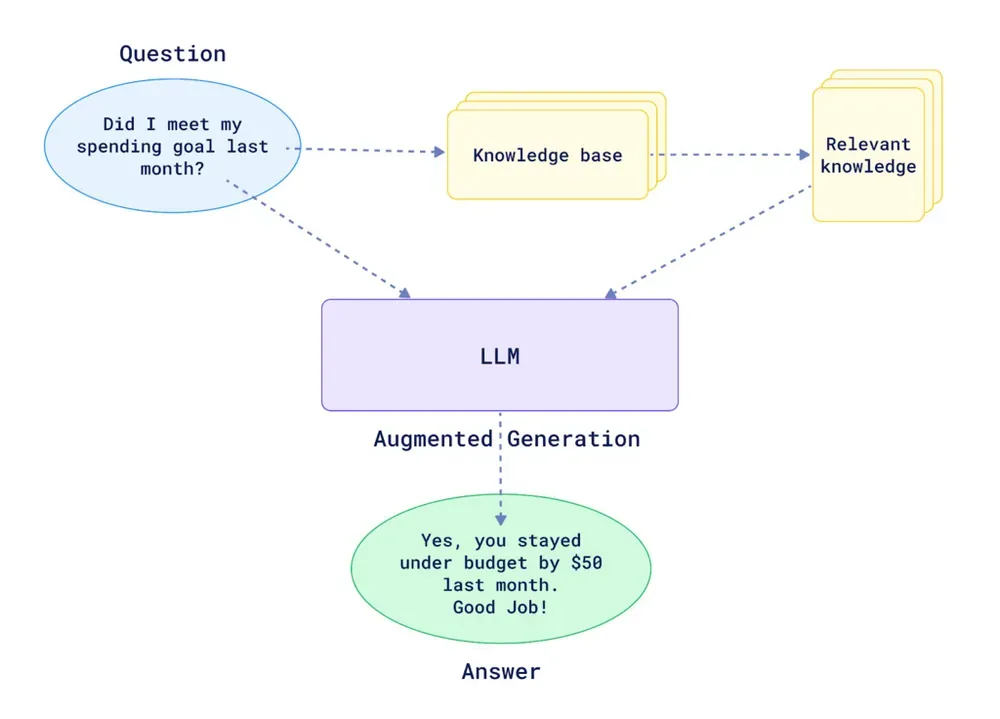
The “new way” of programmatic SEO relies on Retrieval-Augmented Generation (RAG).
Instead of asking an AI to “write an article about X” (which results in generic fluff), RAG allows you to upload your internal documents—PDFs, whitepapers, internal wikis—and force the AI to write using only that derived knowledge.
This allows you to scale expertise without scaling headcount.
1. Curate your internal expertise
Before you build any automation, you need to consolidate your “source of truth.” DO NOT rely on the general training data of models like GPT-4 or Claude, as they hallucinate and lack your specific brand voice.
Identify the documents that contain your company’s “brain juice”:
- Methodology guides unique to your service.
- Case studies and customer success stories.
- Internal technical documentation.
- Transcripts from sales calls or expert interviews.
2. Store and retrieve with Lookio
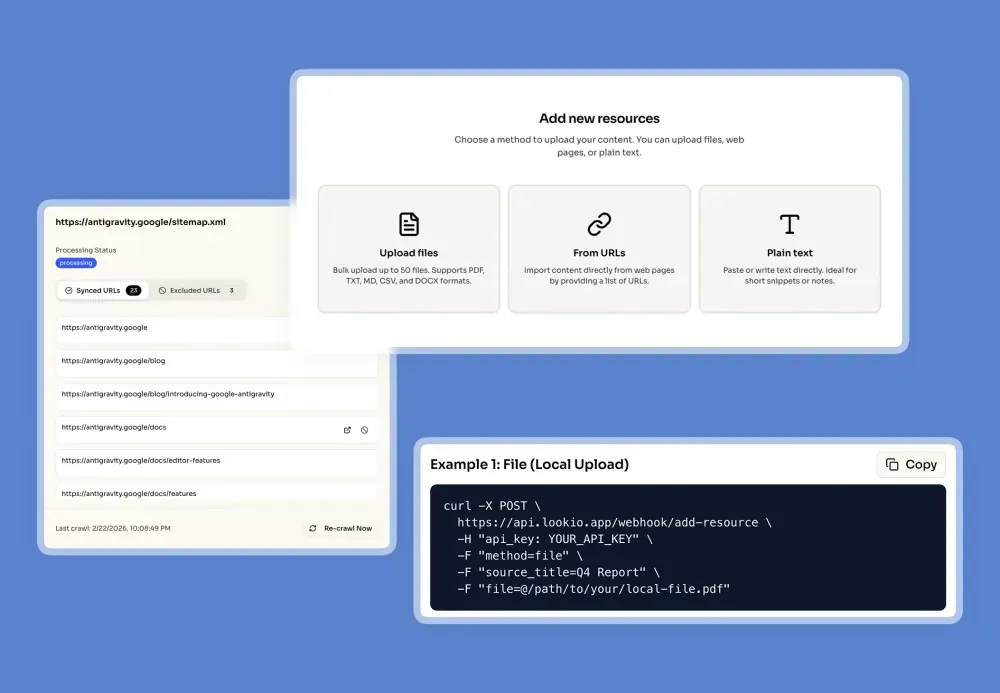
You need a place to store this data where it can be accessed programmatically.
While tools like NotebookLM are fantastic for personal research, they lack an API, making them useless for automated SEO at scale. Lookio is built specifically for this workflow. It acts as the bridge between your static documents and your automation pipeline.
You can upload your PDFs and guidelines into a dedicated Assistant within Lookio. This assistant becomes your “Expert on Demand.”
3. Automate the research
This is the core of the strategy. Instead of a human manually looking up facts for every programmatic page, you set up a workflow (using tools like n8n or Make) that reads your content brief and instantly retrieves every relevant insight needed for the piece.
Here is the optimal process:
- Define the trigger: A row in a Google Sheet or CSV containing your target keyword (e.g., “How to automate payroll in Germany”).
- Query the Expert: Your automation sends that topic to the Lookio API.
- Retrieve Context: Lookio searches your uploaded documentation (e.g., your 200-page German compliance PDF) and extracts the exact paragraphs relevant to “payroll automation.”
- Generate Draft: The workflow passes those verified facts to an LLM to write the final section.
A practical workflow example
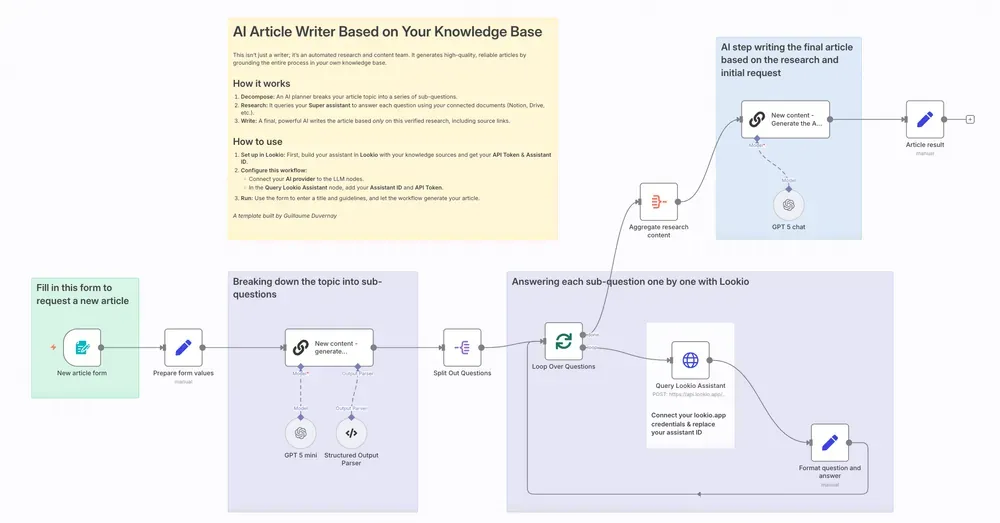
Let’s look at how to build this. We will use a standard automation platform like n8n combined with Lookio’s API.
If you are looking for a pre-built setup, you can check out this n8n template to automate the generation of high-quality sourced SEO articles.
In this workflow, we aren’t just swapping variables. We are generating unique, deeply researched content for every single keyword.
The API configuration
To get high-quality answers, you need to query your assistant correctly. Here is exactly how to structure the API call to your Lookio assistant within your automation tool.
NB: You can choose your query_mode. For bulk programmatic pages where cost efficiency is key, use "flash" (3 credits). If you are generating “pillar pages” that require complex synthesis of multiple documents, use "deep" (20 credits).
curl -X POST \
  https://duv-inc-webhook.up.railway.app/webhook/lookio-query \
  -H "Content-Type: application/json" \
  -H "api_key: YOUR_API_KEY" \
  -d '{
    "query": "Explain the specific regulations regarding [Insert Keyword Variable] based on our internal compliance guide.",
    "assistant_id": "YOUR_ASSISTANT_ID",
    "query_mode": "flash"
  }'
By looping this request through a CSV of 500 topics, you are essentially “hiring” your internal experts to write 500 summaries instantly.
Why this beats generic AI content
The internet is currently flooded with “slop”—low-quality, AI-generated content that reads the same. Google is aggressively filtering this out.
By using Lookio to inject proprietary knowledge into your programmatic strategy, you solve the Volume AND quality dilemma.
- Uniqueness: Your content contains insights found only in your documents, not in the general web data.
- Safety: RAG significantly reduces hallucinations. If the answer isn’t in your docs, the assistant won’t make it up.
- Efficiency: You save hours of digging through your knowledge base and finding the right internal links.
Getting started
Programmatic SEO is no longer about tricking the algorithm with variable swapping. It is about operationalizing your company’s knowledge.
If you are ready to scale your content marketing using your own data, create a free Lookio account. You will get 100 free credits to build your first assistant and test the API without needing a credit card.
For those ready to dive deeper into automation, check out our library of templates to deploy these workflows in minutes. Or, if you want to see exactly how much this costs at scale, take a look at Lookio’s pricing—our credit packs never expire, making it easy to experiment.